Sunday, 21 April 2013


Contingency Plan

Netball Match


  •   Not enough players- If the team hasn't got enough players then ask the opposition if it would still be okay to play the match. If it the opposite and the other team hasn't got enough player still play the game but do not count the points and have a rematch when there will be enough players.
  •     Sports hall occupied- If the sports hall is in use then go out to the outside courts and play on the outside courts.
  •   Weather- If the spots hall is in use and we have to use the outside courts and the weather is bad then there will have to be a rematch.
  •    Injury- If injury occurs in the match ensure that the coach has subs to take place of the injured player.

Risk Assessment

General Risk Assessment Form

Date: 27/03/13                    Assessed by: Megan Kew                Location: Sports Hall

Event: Netball                           

Activity
Hazard
Persons in danger
Severity (s) 1-10
Likelihood (L) 1-10
Result (SxL)
Control Measures
Setting up netball posts
·         Manual handling
·         Broken netball post
·         Injury
·         Coach
·         Players
3
3
9
·         Ensure that the coach has told the players on how to put up the netball posts
·         Do not use broken equipment
·         Ensure that the coach can observe the players putting up the posts and give out instructions.
Warm Up
·         Injury
·         Slippery Surface
·         Water bottles
·         Benches
·         Players
·         Coach
4
3
12
·         Ensure that all benches are out of the way of the netball court (in storage)
·         Put all water bottles In the corner of the sports hall so they are out of the way so no one trips over and fall over them
·         The coach needs to ensure that all the players have warmed up correctly so injury doesn’t occur when playing the game.
·         Also that all players have the correct footwear on so they do not slip and the players have correctly tied their shoes.
Netball Match
·         Injury
·         Slippery floor
·         Walls
·         Players
3
2
6
·         Players have the correct foot wear and they have tied them correctly
·         Ensure that the players have warmed up


Key
Low Risk 0-20
Medium Risk 20-40
High Risk 40+

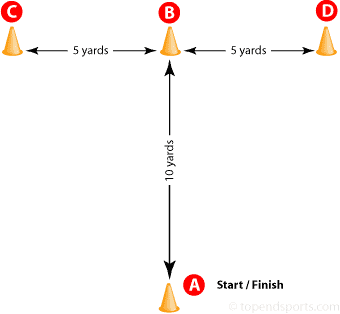
Power, speed and agility- The T-test


Sometimes you need to test for a combination of physical and motor-fitness skills. The t-test is a measure of an athlete’s power, speed and agility. This test is excellent for athletes involved on sport that require sprinting and quick changes of direction eg) tennis, squash, rugby, football and netball.
You will require the following equipment:

  •        4 cones or markers
  •       Stopwatch
  •        Flat surface such as a running track or sports hall
  •       Tape measure


  •     Warm up by jogging/running for five minutes
  •      Start at point A to the left of the cone
  •      Person recording the time shout “GO” and start timing using the stopwatch
  •     Sprint to point B ad touch the cone
  •     Side step to the left and touch cone C. He/she must stay facing forward and not let their feet cross over
  •      Side step 10 yards to the right and touch cone D
  •     Side step 5 yards to the left and touch cone B
  •     Run backwards to the start position passing cone A- person timing stops the stopwatch
  •     The athlete has to rest and repeats the test
  •      The test is invalid if the athletes does not touch the cone, crosses their feet or stops facing forward
  •         Take the athlete’s best score and assess it against the table below


Name
Attempt time 1 (seconds)
Attempt time 2 (seconds)
Mean
Millie
11.5
12
11.75
Darby
10
11.5
10.75


Time in seconds
Male
Competitive athletes
10

Recreational athletes
10.5

Sedentary athletes
11.1
Female
Competitive athletes
10.8

Recreational athletes
12.5

Sedentary athletes
13.5

http://www.topendsports.com/testing/images/t-test.gif [accessed online] [March 25th 2013]


The vertical jump test


Power is the production of strength at speed and can be seen when we throw an object or perform a sprint start. We look here at the vertical jump test. This test of power with the aim being to see how high the athlete can jump. It is important that you find a smooth wall with a ceiling higher than the athlete can jump. A sports hall or squash court is ideal. The test is conducted in the following way.


  •      The athlete rubs chalk on their fingers
  •       They stand about 15cm away from the wall
  •      With their feet flat on the floor they reach as high as they can and make a mark on the wall
  •       The athlete then rubs more chalk on their fingers
  •      They bend their knees to 90 degrees and jump as high as they can up into the air
  •          At the top of their jump they make a second chalk mark with their fingertips
  •      The trainer measures the differences between their two marks; this is their standing-jump score
  •     This test is best done three times so the athlete can take the best of their three jumps


Rating


Males (cm)
Females (cm)
Excellent
>70
>60
Very Good
61-70
51-60
Above average
51-60
41-50
Average
41-50
31-40
Below average
31-40
21-30
Poor
21-30
11-20
Very poor
<21
<10
Categories for power scores (adapted from Franklin, 2000 within Stafford-Brown&Rea, 200)


Name
Attempt 1 (cm)
Attempt 2 (cm)
Attempt 3 (cm)
Mean
Rating
Millie
20
19
21
20
Poor
Darby
25
27
28
26
Below Average


Reaction Time Test


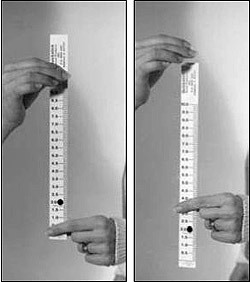
  • ·         Get a 30 cm ruler
  • ·         One person holds the ruler near the 30cm mark and hangs it vertically
  • ·         The other person places their thumb and index finger either side of the 0cm mark ready to catch it when it falls- their fingers shouldn't touch the ruler
  • ·         Without warning the person holding the ruler lets go and the subject tries to catch the ruler as soon as possible- to prevent guessing, vary the time before letting go.
  • ·         The level(in cm) just above the subjects first finger where the ruler was caught is recorded
  • ·         The same person is tested five times and the mean average of their results is calculated (add all five numbers together divide by five)
  • ·         Swap over and test your partner


Name
1st attempt
2nd attempt
3rd attempt
4th attempt
5th attempt
Average
Reaction time (ms)
Rating
Millie
16 cm
11.5 cm
19 cm
18 cm
14 cm
15.7 cm
170
Excellent
Darby
17 cm
13 cm
18 cm
15cm
11 cm
14.8 cm
170
Excellent


Results

From the table below the ‘mean catch distance’ on the ruler can be converted into a ‘mean reaction time in milliseconds’. 1 millisecond is one thousandth of a second.


Distance- reaction
Time conversion
table
Catch Distance
Reaction Time (millisecond)
Catch Distance (cm)
Reaction Time
(millisecond)
1
50
16
180
2
60
17
190
3
70
18
190
4
80
19
200
5
90
20
200
6
100
21
210
7
120
22
210
8
130
23
220
9
140
24
220
10
140
25
230
11
150
26
230
12
160
27
230
13
160
28
240
14
170
29
240
15
170
30
250

Reaction Time (milliseconds)
Rating
0-50
Ultra-Fast
50-130
Superb
131-175
Excellent
176-200
Good
201-240
Average
241-250
Fair
251+
Slow
http://www.topendsports.com/testing/images/quickstick.jpg [accessed online] [March 25th 2013]